11-Day Residential Capacity-Building Programme on National Security Journalism - Batch 1
Description
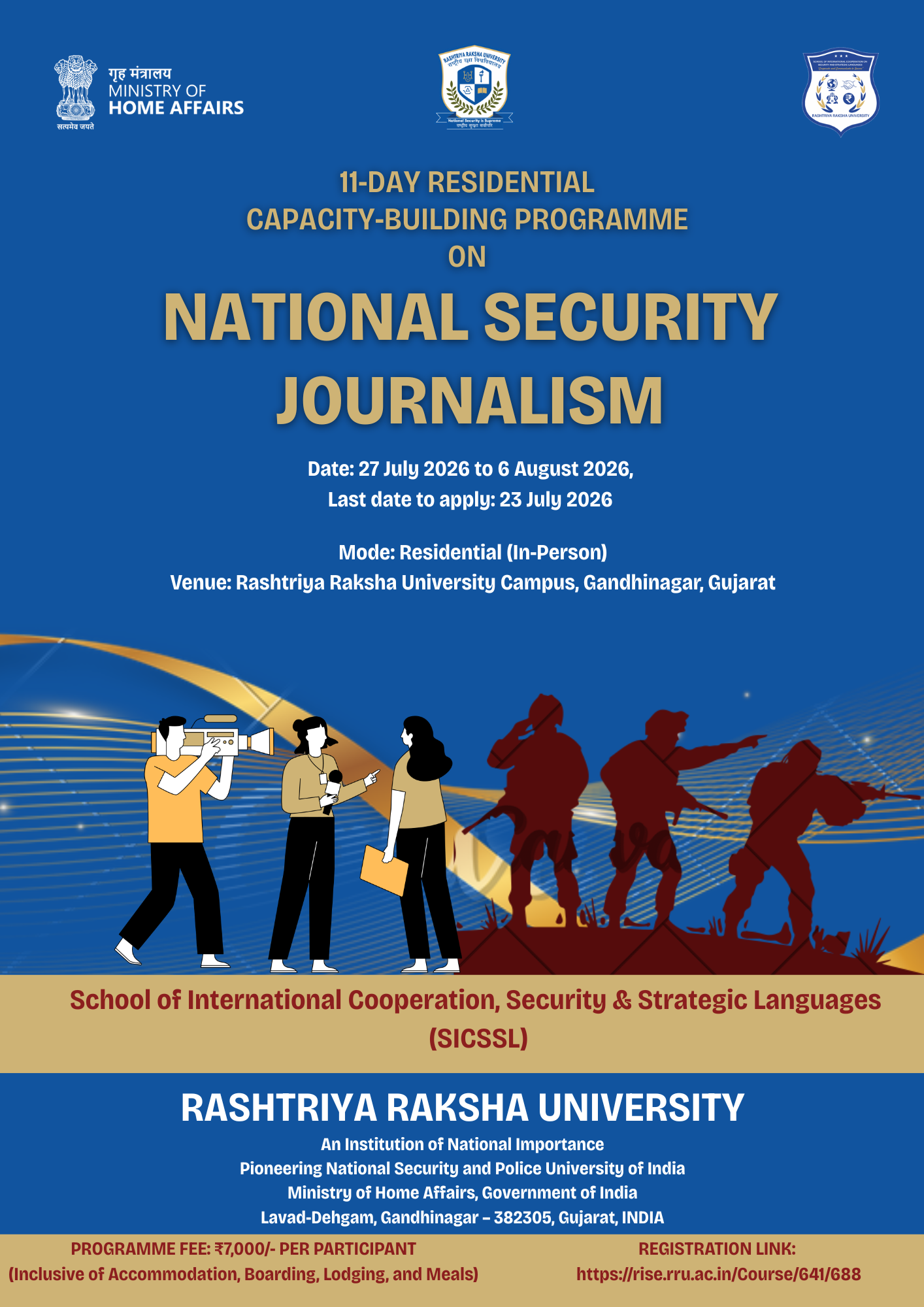
The National Security Journalism Programme is proposed as an 11-day residential capacity-building initiative at Rashtriya Raksha University, Gandhinagar, Gujarat, from 27 July 2026 to 6 August 2026, for a select cohort of 30 journalists from national, state and regional media organisations.
The programme aims to develop a cadre of journalists and communicators who can report on India’s national security with accuracy, responsibility and strategic understanding. It will combine expert-led sessions, practitioner interaction, case-based learning, practical tools and structured field exposure.
The focus is to build professional capacity, technical know-how and confidence among journalists working in sensitive information environments. The programme is especially relevant for those reporting on defence, internal security, terrorism, border management, coastal security, cyber incidents, public order, disasters, critical infrastructure and related security matters.
A defining feature of the programme is its field-immersion component. Participants will be taken to key national security and internal security institutions for first-hand exposure to the operational realities of organisations that safeguard the nation.
What you'll learn
Develop a clearer understanding of India’s national security architecture and key institutions.
Understand how information is cognitively processed and how media framing shapes public perception during security events.
Use OSINT, AI and digital verification tools more responsibly for information gathering and fact-checking.
Strengthen information security, source protection and ethical handling of sensitive material.
Build professional linkages with security practitioners, public relations officials and fellow journalists.
Report security-related developments with greater context, accuracy and professional responsibility.
Assess the impact of media reporting on national security outcomes through case studies.
Identify misinformation, disinformation, influence operations and hostile narratives with greater precision.
Gain first-hand exposure to national security institutions through structured field visits.
Requirements
Course Content
Semester with subjects
 No Semester Founds.
Experts
Shivam Kumar
Recent Reviews