
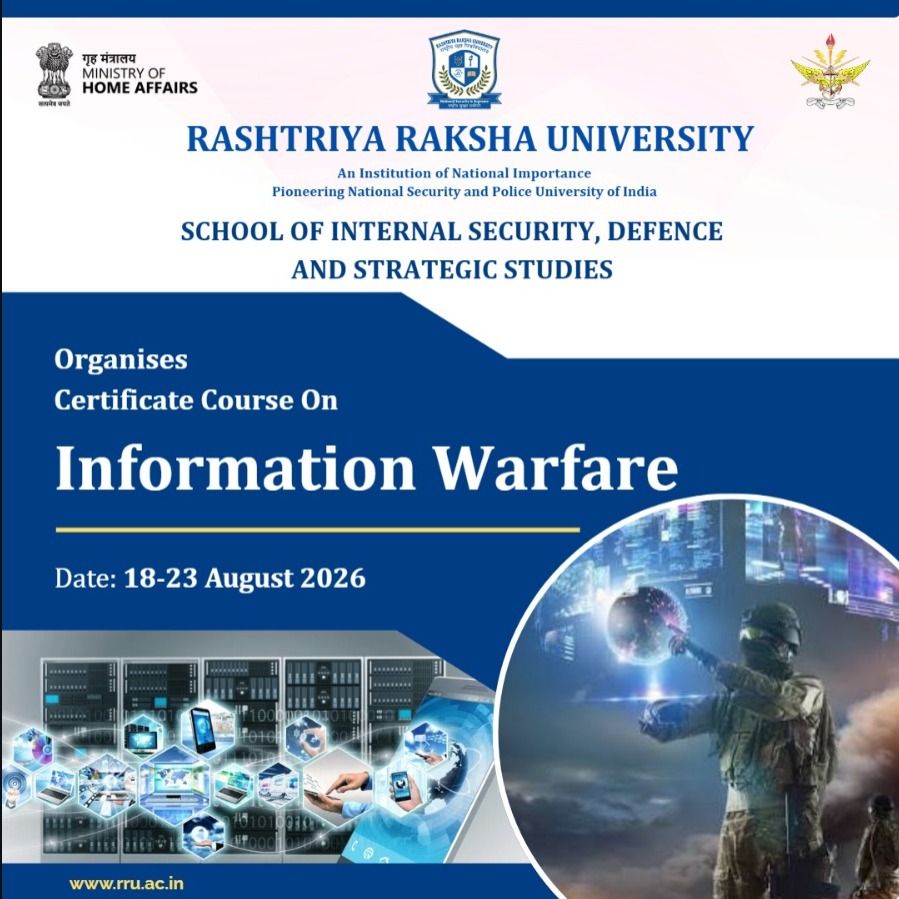
Description
In an era where information itself has become both a strategic resource and a weapon, Information Warfare (IW) has emerged as one of the most consequential dimensions of contemporary conflict. States and non-state actors alike now wield information, cyber capabilities, artificial intelligence, and psychological influence campaigns to shape perceptions, manipulate decision-making, and achieve strategic objectives — often without a single shot being fired. As generative AI accelerates the scale and sophistication of disinformation, deepfakes, and algorithm-driven narrative amplification, the line between peace and conflict has never been more contested.
This 36-hour certificate course offers a comprehensive introduction to the concepts, doctrines, and practical tools that define modern Information Warfare. Across six days, participants will explore the foundations of IW and psychological operations; examine comparative case studies of IW structures in India's neighbourhood, including Pakistan and China; assess the convergence of cyber warfare, electronic warfare, and AI within the IW ecosystem; and gain hands-on experience with analytical frameworks such as the Target Audience Analysis Worksheet (TAAWS) and the OODA Loop. The course culminates in a focused study of social media, strategic communication, and perception management as force multipliers in the information domain.
Designed for policymakers, defence professionals, researchers, media practitioners, and students of strategic studies, the course combines theoretical grounding with applied analysis — equipping participants to understand, evaluate, and respond to the evolving information threats shaping national security and democratic resilience today.
What you'll learn
Explain the fundamental concepts, doctrines, evolution, and strategic significance of Information Warfare in the contemporary security environment.
Evaluate the information warfare capabilities, organisational structures, and operational approaches adopted by major state actors through contemporary case studies.
Apply analytical tools such as the Target Audience Analysis Worksheet (TAAWS) and the OODA Loop framework to design and evaluate information operations.
Analyse the role of psychological operations, cognitive influence, perception management, and strategic communication in Information Warfare campaigns.
Assess the integration of cyber operations, electronic warfare, artificial intelligence, and emerging technologies within the broader Information Warfare ecosystem.
Develop a comprehensive understanding of social media dynamics, disinformation campaigns, and media literacy to identify, assess, and respond to contemporary information threats.
Requirements
Course Content
 No Content Founds.
Semester with subjects
No Semester Founds.
Experts
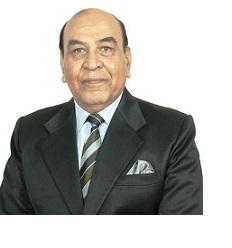
Lt Gen Syed Ata Hasnain
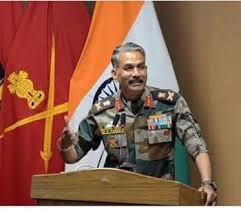
Lt Gen D.P. Pandey, PVSM, UYSM, AVSM, VSM
Former Lieutenant General
Deepak Kumar Tiwari 08 Aug, 2026
Good
Thank you rru